2D vs 3D Animation: Choosing the Right Approach for Your Business in Bangalore

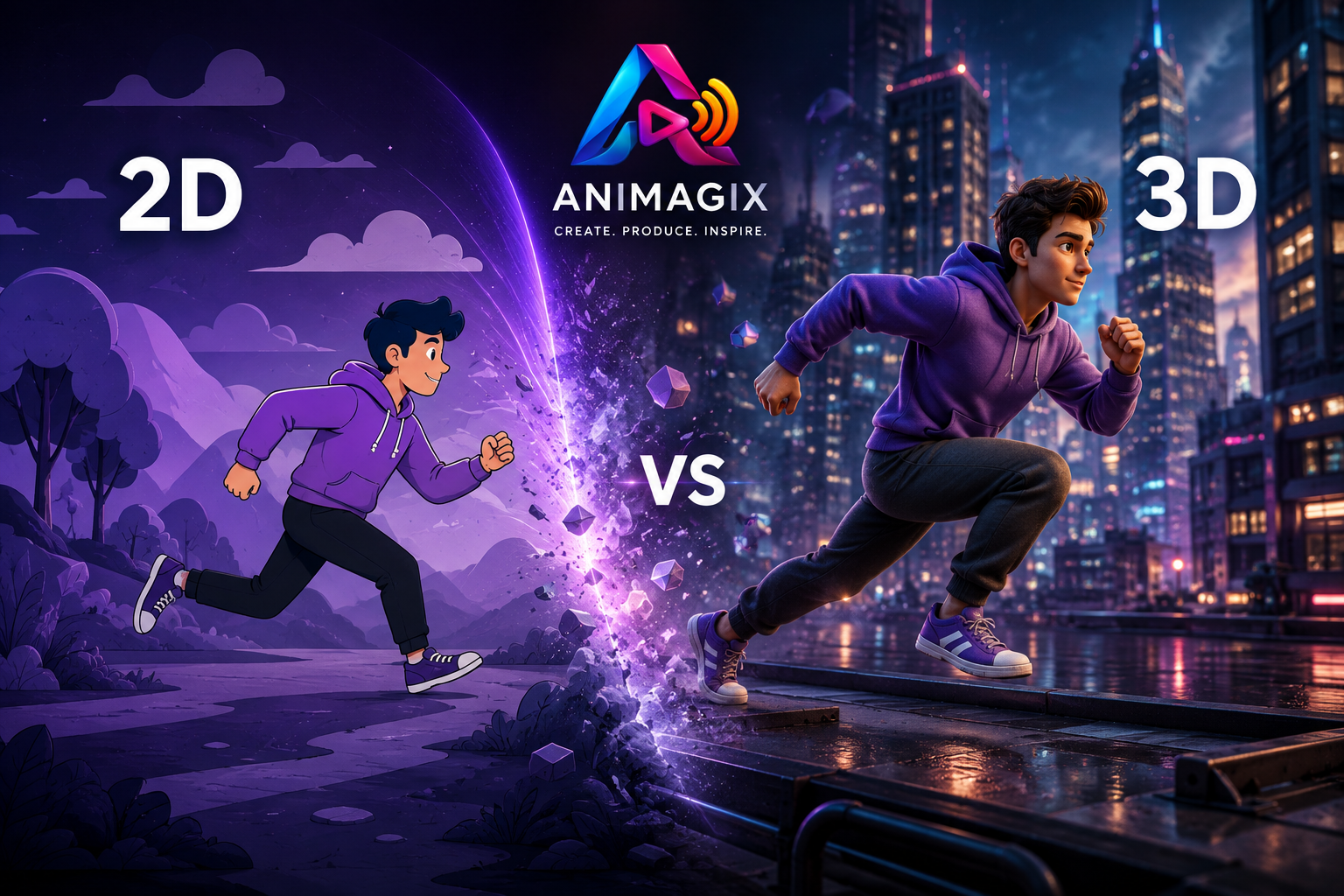
Animation can make complex ideas easier to understand, products more engaging, and marketing content more memorable. For businesses in Bangalore, Koramangala — the heart of India's startup and creative ecosystem — animation has become an essential tool for brand storytelling and product communication.
But when planning an animation project, businesses often face one important question:
Should we use 2D or 3D animation?
There is no universal winner.
The right choice depends on your objective, audience, product, visual style, budget, timeline, and where the animation will be used.
2D animation can be ideal for explainers, educational content, social media, storytelling, and brand communication.
3D animation can be especially effective for products, technology, architecture, simulations, cinematic visuals, and situations where depth and realism are important.
The best choice is the one that communicates your idea most effectively.
What Is 2D Animation?
2D animation creates movement within a two-dimensional visual environment.
It commonly uses: Illustrations · Characters · Shapes · Typography · Icons · Graphics · Flat compositions · Motion graphics
2D animation can range from simple motion graphics to highly detailed character animation.
Common examples include: Explainer videos · Educational videos · Social media animations · Infographics · Brand videos · App demonstrations · Animated presentations · Character stories
For businesses, 2D can be an efficient way to communicate ideas without requiring realistic environments or physical production.
What Is 3D Animation?
3D animation creates objects and environments with three-dimensional depth.
It can include: 3D modelling · Texturing · Lighting · Rigging · Character animation · Camera movement · Simulation · Rendering · Visual effects
3D animation is particularly useful when viewers need to see an object, environment, or process from multiple angles.
Common applications include: Product animation · Architecture · Technology · Automotive · Medical visualisation · Industrial demonstrations · Product launches · Cinematic advertising · VFX
2D vs 3D Animation at a Glance
| Factor | 2D Animation | 3D Animation |
|---|---|---|
| Visual style | Graphic and illustrative | Dimensional and realistic/stylised |
| Production | Often simpler | Usually more complex |
| Product visualisation | Good | Excellent |
| Explainer videos | Excellent | Excellent |
| Social media | Excellent | Excellent |
| Character animation | Strong | Strong |
| Realistic environments | Limited | Strong |
| Camera movement | Graphic/2D | Full 3D movement |
| Product angles | Limited | Excellent |
| Modelling required | Usually no | Usually yes |
| Production time | Often shorter | Often longer |
| Technical complexity | Lower to moderate | Moderate to high |
| Best for | Communication and storytelling | Products, environments and realism |
The actual production requirements vary significantly from project to project.
1. Choose 2D When Simplicity Matters
If your objective is to explain an idea quickly, 2D animation can be highly effective.
For example: "How does our software work?"
You may not need a realistic 3D environment. A combination of: Icons + Typography + Illustrations + Motion may communicate the process more clearly.
2. Choose 3D When the Product Is the Story
If your product itself needs to be shown from different angles, 3D can be particularly useful.
For example: Consumer electronics · Machinery · Vehicles · Furniture · Packaging · Medical devices · Industrial equipment
You can show: Internal components · Exploded views · Product rotations · Assembly · Material details · Functional demonstrations
This is one of the strongest use cases for 3D animation.
3. 2D Is Excellent for Explainer Videos
Explainer videos often need to simplify complicated information.
2D animation can use: Visual metaphors · Icons · Diagrams · Characters · Text · Charts · Arrows · Transitions
This allows complex information to be broken into manageable visual steps.
For SaaS companies, EdTech businesses, financial services, healthcare communication, and professional services, this can be particularly useful.
4. 3D Is Powerful for Product Demonstrations
Imagine trying to explain a product using only static photographs. Some features may be difficult to communicate.
With 3D animation, you can: Rotate the product · Zoom into components · Remove outer layers · Show internal mechanisms · Demonstrate movement · Show different configurations
This can make technical products easier to understand.
5. 2D Can Be More Flexible for Social Media
Short-form content often needs to be produced frequently.
2D motion graphics can work well for: Reels · Shorts · LinkedIn · Instagram · Digital advertisements
You can animate: Headlines · Statistics · Quotes · Charts · Product features · Educational points
Because the visual language can be modular, it can also be adapted into a wider content system.
6. 3D Can Create a More Cinematic Experience
When a campaign requires dramatic visuals, 3D can provide significant creative possibilities.
You can control: Camera · Lighting · Materials · Environment · Perspective · Movement · Depth
This allows highly controlled visuals that may be difficult or expensive to achieve through live-action production.
7. Consider Your Audience
Your audience should influence the animation style.
For example: Children: Character-driven 2D or 3D animation may work well. · Technical Professionals: Detailed 3D demonstrations may be more appropriate. · Consumers: Stylised motion graphics or product animation can communicate quickly. · Students: 2D educational animation can simplify complex concepts. · Enterprise Buyers: A polished combination of motion graphics, product visualisation, and live-action content may be appropriate.
Animation should serve the audience—not simply showcase technology.
8. Consider Your Brand Personality
Animation should feel like part of your brand.
A playful company might use: Bright illustration · Expressive characters · Energetic motion
A premium technology company might use: Minimal graphics · Controlled movement · Refined typography · Detailed 3D visualisation
Your brand strategy should therefore influence the creative direction of your animation.
9. Think About the Message
Before choosing 2D or 3D, ask: What does the viewer need to understand?
If the answer is: "Understand this process." — 2D may be ideal.
If the answer is: "Understand how this physical product works." — 3D may be better.
If the answer is: "Feel the possibilities of our new product." — A combination of 3D, live action, motion graphics, and VFX may be stronger.
The objective should determine the technique.
10. Production Complexity Matters
3D animation can require several specialised stages: Concept → Modelling → Texturing → Rigging → Animation → Lighting → Rendering → Compositing
2D may follow a different workflow: Concept → Storyboard → Illustration → Animation → Compositing
Neither is automatically "easy." A sophisticated 2D character animation can be highly complex. Likewise, a simple 3D product rotation may be relatively straightforward. The complexity depends on the creative requirements.
11. Timeline Is an Important Factor
Animation production time depends on: Length · Number of scenes · Complexity · Number of characters · Modelling requirements · Revision rounds · Rendering · Sound design · Visual effects
A simple animation may be produced relatively quickly. A cinematic 3D production may require considerably more development.
If you have a fixed launch date, define the production scope early.
12. Budget Should Follow the Objective
Don't choose 2D simply because you assume it will always be cheaper. And don't choose 3D simply because you assume it looks more premium.
Instead, determine: What does the audience need to see?
Then choose the production method that delivers that communication efficiently.
A short 2D explainer may be the best investment for one company. A detailed 3D product film may be the better investment for another.
13. 2D Animation for Education
Education is one of the strongest applications for 2D animation.
It can help explain: Scientific concepts · Business processes · Historical events · Technical systems · Financial concepts · Medical information · Software workflows
Visual explanations can make abstract concepts easier to follow.
For businesses developing learning content, animation can also become part of a larger EdTech production workflow.
14. 3D Animation for Education
3D can be especially valuable when students need to understand physical structures.
Examples include: Human anatomy · Engineering · Architecture · Manufacturing · Mechanical systems · Scientific models
A 3D model can be viewed from multiple angles and explored visually.
15. Animation for Product Marketing
Product animation can help businesses demonstrate products before customers physically interact with them.
You can show: Product → Feature → Function → Benefit
This can be used in: Websites · Advertisements · Social media · Presentations · Trade shows · Product launches · E-commerce
3D is particularly useful when physical product details are important.
16. Animation for Brand Marketing
Animation isn't limited to explaining products. It can also express the personality of the brand.
Examples include: Logo animation · Brand films · Social animations · Campaign visuals · Motion identities · Promotional videos
A strong motion system can become an extension of your creative and design identity.
17. Motion Graphics Are Different From Full Animation
Motion graphics typically focus on moving: Typography · Shapes · Icons · Illustrations · Charts · Graphic elements
They are often used in: Advertisements · Corporate videos · Presentations · Social media · Explainers · YouTube
Motion graphics can be created in both 2D and 3D environments.
18. When a Hybrid Approach Is Better
You don't always have to choose between 2D and 3D.
A project can combine: Live Action + 2D Motion Graphics + 3D Animation + VFX
For example, a product launch video could show: Founder introducing the product · Live-action product footage · 3D animation of internal technology · 2D graphics showing key benefits · VFX for the final hero sequence
This can create a richer experience.
19. 2D vs 3D for YouTube
Both can work well on YouTube.
2D: Useful for: Explainers · Educational content · Animated stories · Infographics
3D: Useful for: Product demonstrations · Technology · Architecture · Visual experiments · Cinematic content
The key is not the animation type. It is whether the content holds attention and communicates clearly.
20. 2D vs 3D for Advertising
Advertising requires immediate communication.
For short-form campaigns, consider: First-frame impact · Brand recognition · Message clarity · Product visibility · Duration · Platform
2D can communicate a message quickly through graphics. 3D can create highly visual product moments. The best option depends on the campaign idea.
21. 2D vs 3D for Reels
For Reels, animations need to work within a few seconds.
Useful 2D applications include: Animated statistics · Text · Icons · Product features · Visual hooks
Useful 3D applications include: Product rotations · 3D transitions · Cinematic objects · Product reveals
Both can be effective when the concept is strong.
22. Animation Quality Matters More Than the Technology
Using 3D doesn't automatically make a video better. Using 2D doesn't make it less professional.
What matters is: Concept · Story · Design · Animation · Timing · Sound · Brand fit · Technical quality
A simple but well-executed animation can outperform an unnecessarily complicated production.
23. Sound Design Is Important
Animation is visual, but sound can dramatically improve the experience.
Consider: Music · Sound effects · Voice-over · Transitions · Ambience
Good sound can make motion feel more impactful. It can also reinforce brand personality.
24. Don't Animate Everything
Another common mistake is adding movement simply because animation is available.
Ask: Does the movement help communication?
Animation should have a purpose. Use movement to: Direct attention · Explain a process · Reveal information · Create emphasis · Improve storytelling
If everything moves constantly, nothing feels important.
25. How to Choose Between 2D and 3D
Use this simple framework.
Choose 2D if: You need clear explanation · Your content is information-heavy · You want an illustrative style · You need frequent social content · Your concept relies on graphics · You want a stylised visual language
Choose 3D if: You need realistic product visualisation · The object has complex physical features · You need multiple viewing angles · You need cinematic environments · You need detailed simulations · Depth is important to the story
Choose Hybrid if: You need live-action plus animation · You want both explanation and realism · The product requires 3D but the campaign needs people · You need multiple visual styles within one campaign
2D vs 3D Decision Checklist
Before starting, ask:
- What is the objective?
- Who is the audience?
- What must they understand?
- What must they feel?
- Is the product physical or conceptual?
- Is realism important?
- Is illustration more appropriate?
- Where will the animation be used?
- What is the required duration?
- What is the production timeline?
- What is the available budget?
- Does the style match the brand?
- Can the animation be repurposed?
If you're looking for professional animation and VFX services in Bangalore, Koramangala, Animagix Animation & VFX offers 2D animation, 3D animation, motion graphics, and VFX for businesses, creators, and brands.
How Animagix Can Help
Animation becomes more effective when it works as part of a larger content and brand system.
Animagix combines animation and VFX with creative, content, production, and digital capabilities.
Depending on the project, animation can support: Brand campaigns · Product videos · Explainers · Social media · YouTube · Educational content · Corporate videos · Product launches · Motion graphics
The objective is to select the right visual technique for the communication goal rather than using animation simply for visual effect.
Explore Animagix Animation & VFX, Creative & Design, or Content & Production to see how we can help bring your ideas to life.
Frequently Asked Questions
Is 2D animation better than 3D animation?
Neither is universally better. 2D is often excellent for explainers, graphics, education, and storytelling, while 3D is particularly useful for products, environments, simulations, and realistic visualisation.
Is 3D animation more expensive than 2D?
It can be, particularly when the project requires detailed modelling, texturing, lighting, simulation, and rendering. However, the actual cost depends on the scope and complexity.
Which is better for an explainer video?
Both can work. 2D is often effective for process-driven explainers, while 3D can be useful when the subject requires realistic objects or environments.
Which is better for product animation?
3D is often particularly useful because it allows products to be rotated, opened, exploded, and visualised from different angles.
Can 2D and 3D animation be combined?
Yes. Many projects combine 2D motion graphics, 3D animation, live action, and VFX.
Is 2D animation good for social media?
Yes. Motion graphics, typography, illustrations, and animated product features can work well in short-form social content.
How long does animation production take?
It depends on duration, complexity, number of scenes, modelling requirements, animation style, revisions, and post-production.
Does animation help marketing?
It can. Animation can explain complex ideas, demonstrate products, support campaigns, and create engaging visual content when it is aligned with a clear communication objective.
Where is your animation studio located in Bangalore?
Animagix studio is located at StartupHuts Workspace, Ashoka Fortune, 3rd Floor, 1st Main Road, 1st Block, Koramangala, Bengaluru, Karnataka 560034.
Final Thoughts
There is no universal answer to 2D vs 3D animation.
2D can be powerful because it simplifies information, supports storytelling, and provides flexibility for graphic communication.
3D can be powerful because it creates depth, realism, product visualisation, and cinematic possibilities.
And sometimes the strongest solution is neither one alone.
The right animation style is the one that makes your message easier to understand and your brand easier to remember.
Before deciding, start with the objective. Then consider the audience, product, story, platform, timeline, and budget.
Choose the technology that serves the idea—not the other way around.
If you're planning animation for your business in Bangalore, explore Animagix Animation & VFX, Creative & Design, or contact the team.
Ready to Bring Your Ideas to Life with Animation?
Whether you need 2D explainers, 3D product demos, or motion graphics for social media — we can help.
📩 Download the Free Animation Strategy Guide
Get a step-by-step guide to choosing the right animation style for your business.
No spam. Unsubscribe anytime.